
Emergency Air Duct Cleaning Near Me: What Tempe Homeowners Should Do First
If you’re smelling smoke, rodent odor, or mold through your vents right now, the first call probably isn’t to a duct cleaner. It’s to whoever can stop the source, because cleaning a duct system while the contamination is still active accomplishes nothing. Smoke keeps entering every time the blower runs if the fire is still smoldering somewhere. Rodent activity continues as long as the entry point is open. Mold keeps spreading while the moisture source stays wet. So before you book anyone, you need to answer one question honestly: is this a cleanup job, or is it still an active problem?
That distinction is the whole game. The same symptoms can point to a five-minute fix or a remediation-grade response, and the order you handle them in changes the outcome. If you’d rather not sort through it alone, call (866) 261-1801. We answer 24/7. Fast dispatch from 7am to 7pm, Sunday through Friday.
Why “Emergency Duct Cleaning” Isn’t Always a Cleaning Problem
Here’s what we’ve learned the hard way: a duct system is a delivery network for whatever is downstream of it. If a contaminant is active, your HVAC is its best friend. It pulls air through returns, pushes it through supply trunks, and distributes it across every room it serves. Running the system during an active contamination event spreads the problem into places a cleaner then has to chase down. That’s why the sequence matters more than the service.
Before you schedule anything, run through this quick check:
- Is the source controlled? Fire out, rodent entry sealed or trapped, moisture stopped, dust storm settled and windows closed.
- Is the system on or off? In most contamination events, it should be off until the source is stable.
- Is the smell constant or only when the fan runs? Constant suggests a source in the living space. Fan-dependent suggests it’s inside the ductwork and needs professional investigation.
- What’s your evidence? Photos, dates, when symptoms started, HVAC runtime. Collect it now, not later.
Most of what homeowners call a duct emergency in Tempe is actually one of four scenarios. Each one plays out differently. Getting the order right before a technician arrives protects your home, protects any insurance claim, and prevents the cleaning crew from cleaning ducts that get recontaminated within a week.
The Four Most Common Duct Emergencies in Tempe (and How to Triage Each)
Tempe homeowners tend to face the same handful of situations. The response sequence differs by scenario, and getting it wrong is expensive. Here’s how we usually advise a homeowner to sort the situation before anyone pulls into the driveway:
- Post-fire smoke infiltration. The fire is out, but the smell persists and worsens when the fan runs. Turn the system off, open windows to ventilate the living space, and document the smell with photos of anything visibly soiled. Don’t run the blower to “test it” – soot particles lodge deeper into duct liners each time.
- Rodent intrusion. Droppings in returns, scratching in vents, or musty animal odor with a fan-dependent pattern. Don’t run the system. A rodent problem is a containment job first, cleaning job second. Get the entry point identified and sealed before anyone cleans a duct or you’ll clean it twice.
- Monsoon-related moisture. Humidity intrusion, roof leaks, or wall leaks feeding moisture into the system. Confirm the leak is stopped first. Ducts that stay damp grow biological growth quickly in summer heat, and cleaning wet ducts accomplishes little until they can dry. This is one of the clearest cases where remediation-grade containment matters.
- Haboob dust saturation. A dust storm forces fine particulate through every gap and return, coating the system with a fresh layer of dust. Usually the easiest of the four, but run the fan only after the dust has settled and windows are shut, or you’re just cycling the outdoors through your home.
Each scenario has a different answer to the same question: does this need containment, or standard cleaning? We’ll get to that distinction in a moment.
Why System Shutdown Timing Matters
If there’s one piece of advice we repeat more than any other, it’s this: turn the system off. Not forever. Just until the source is stable and someone who knows what they’re looking at can assess it. Every hour of runtime after a contamination event pushes the offending particles further into the supply trunks, into flex duct elbows, and into the air handler where they can settle onto the coil.
When to shut the system down:
- Smoke or fire residue – shut it off immediately and keep it off until after the assessment.
- Rodent activity – shut it off. You do not want more air movement across a contaminated return.
- Active water intrusion – shut it off and address the leak, then let the system dry before running it.
- Haboob dust – shut it off and keep doors and windows closed until the dust settles.
Running it “just to see if the smell clears” is a normal instinct. It makes the eventual job bigger more often than it fixes anything. During Tempe’s summer, the temptation to let the AC run is real, and we understand that. If you’re genuinely unsure whether the situation is safe to keep running, that uncertainty is worth a phone call.
What to Document Before a Technician Arrives
Documentation is the least glamorous part of this and the most useful. If the cleaning is tied to an insurance claim (post-fire, water intrusion, rodent damage), what you capture in the first hours often determines how smooth the claim goes. We’ve seen claims drag on for weeks over something as simple as a missing before photo.
Here’s what to gather before anyone arrives:
- Photos of every vent you can safely access, especially returns. Note which rooms show visible soiling.
- A short timeline – when symptoms started, when the fan was last run, when the source event occurred.
- HVAC runtime notes – whether the system was on or off, and for roughly how long, after the contamination began.
- Insurance reference information – policy number to yourself, claim number if already open, and any adjuster contact.
- Any contractor reports – inspection notes from the fire department, a roofer, or a pest control company.
You don’t need a form to do this. A phone with photos and a note app covers it. What matters is that the record reflects the state of the system before any cleaning work begins.
Standard Cleaning vs. Remediation-Grade Containment: How to Tell
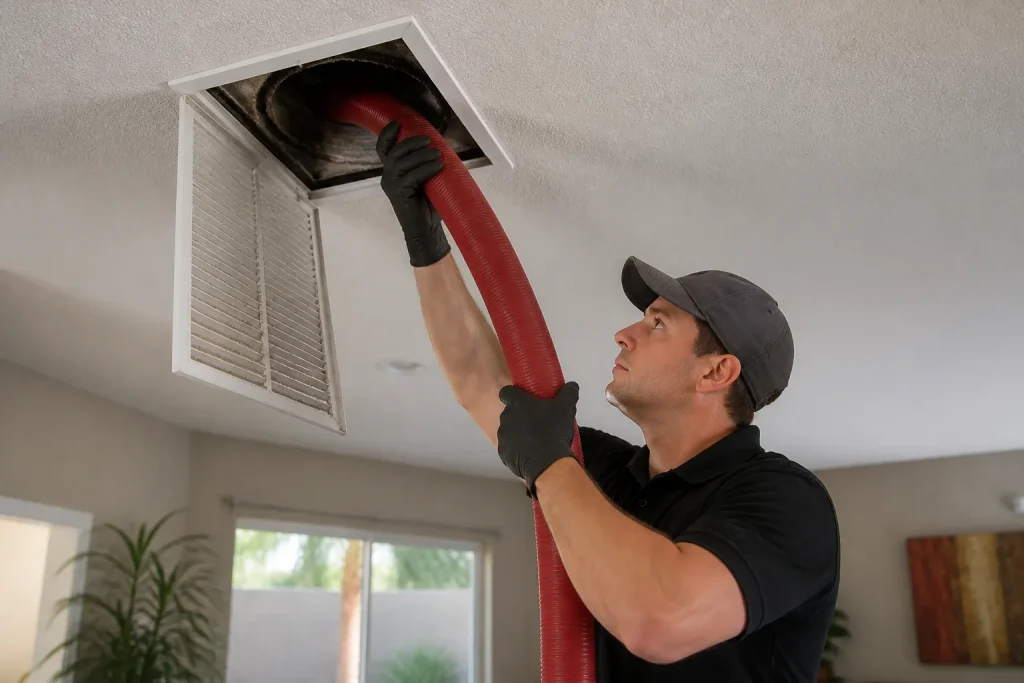
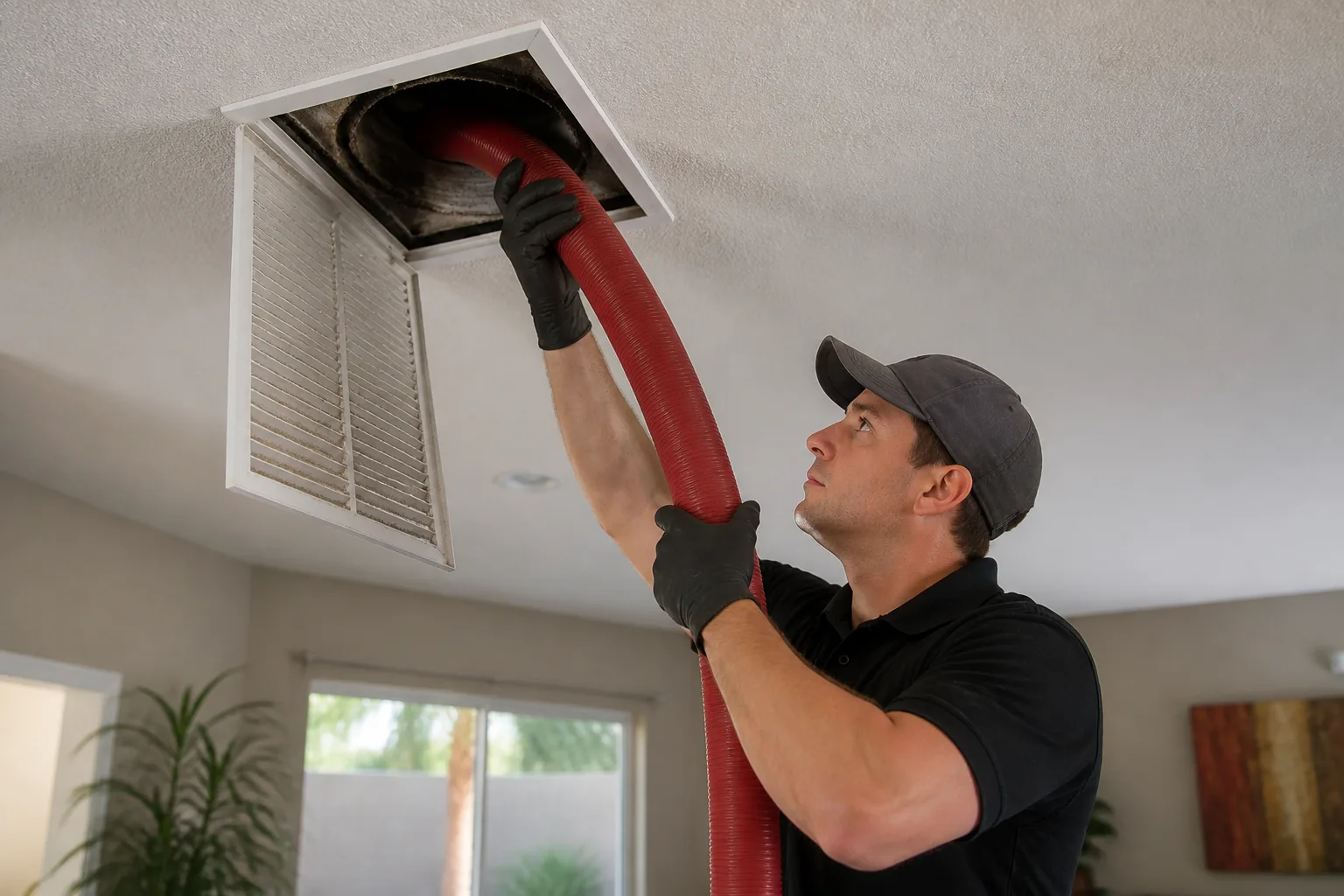
This is where a lot of homeowners underestimate the job. Standard duct cleaning – mechanical agitation with negative-pressure capture – is the right answer for a dusty system, a post-haboob cleanup, or routine maintenance after dryer vent debris has been cleared. It’s thorough, and when it’s done with professional equipment, it makes a real difference.
Remediation-grade work is a different tier. It’s what a situation calls for when contamination is heavy enough to require broader containment: significant fire or smoke residue, mold-growth suspicion, extensive rodent contamination. That’s where air filtration equipment like Abatement Technologies units comes in – the same equipment class used in professional mold and remediation work. It’s not a marketing label. It’s a different setup, and it takes more space to run properly.
Our approach uses Rotobrush rotary-brush systems for mechanical agitation paired with Nikro negative-air machines to capture dislodged debris at the source. That combination matters more than a bigger vacuum: you’re not just pulling dust out, you’re dislodging it first and then trapping it under negative pressure so it doesn’t migrate into the living space. For a heavy-contamination job, we bring Abatement Technologies filtration because the containment requirements are different.
How do you know which one you need? A useful guideline: if the smell is fan-dependent only, standard cleaning plus equipment is usually right. If the smell is present constantly or you’ve had water or rodent contamination, assume remediation-grade until a technician has inspected. Underestimating the tier is the single most common cause of needing a second cleaning.
What to Do If You Have No Idea Which Scenario You’re In
Call. The triage question is not something you should have to solve alone, and it’s not always obvious which scenario applies – a rodent problem can smell like mold, and a small water leak can look like a post-haboob dust issue until the wall is checked. When you call, we’ll walk through the scenario, ask whether the system is on, and help you decide the next step. In many cases the honest answer is “shut it down and let’s look at it.”
In our experience, homeowners who call early spend less, get a clearer picture, and avoid the second-guessing that comes with waiting. Our technicians have up to 10 years of experience with Tempe-area systems, and they can assess what’s actually happening inside the ductwork rather than guess from the smell. Call (866) 261-1801. We answer 24/7. Fast dispatch from 7am to 7pm, Sunday through Friday.
How to Actually Tell It’s a Job for a Professional
Some duct situations are fine to handle with a vacuum and a shop towel. Others aren’t. The line between them:
- Contamination is visual and inside the ductwork – call a professional. A shop vac won’t reach it and a consumer brush won’t dislodge it.
- The system has any moisture history – call a professional. If there’s any chance mold growth is present inside the ductwork, the assessment needs to come before any cleaning.
- The symptom returns after cleaning – call a professional. Recurring symptoms mean a source is still active.
- You’re filing an insurance claim – call a professional with the equipment and documentation to support the claim.
If it’s a post-haboob dust layer on the inside of the return, we’d typically say standard cleaning is the right call rather than remediation-grade. If it’s fire residue, rodent activity, or anything moisture-related, we’d say the opposite. Getting that one call right saves the homeowner from doing the job twice. For our part, we offer air duct repair as well, because sometimes the problem is compromised ductwork, not just a layer of debris. That’s one of the most useful discoveries a proper inspection turns up.
Realistic Response Times from Tempe Duct Cleaning Companies
Let’s talk about “emergency service” honestly. No residential duct cleaner operates a fire-truck model. A duct cleaning job typically takes a scheduled window of a few hours, uses specialized equipment, and requires access to every vent in the home. That reality doesn’t fit an “on-call ambulance” framing.
What a realistic, well-run response looks like:
- Phone triage is immediate – a real conversation about whether the situation requires shutdown and how soon someone should be there.
- Scheduling happens inside normal dispatch windows – and if a call comes in after those windows, it’s booked into the next opening.
- The job is scheduled based on severity – heavy contamination and insurance-related work typically get moved up.
What to look out for: companies that promise a technician within minutes at no cost, or discount framing that ends up producing a much larger invoice once the equipment is unpacked. The bait-and-switch reputation of this industry is earned. A better test is whether the company will tell you openly what tier of work you need before you book. We do one flat price per system, agreed before work starts, no per-vent pricing, and we take before-and-after photos of your own ducts. When the right filtration upgrade makes sense for the home after cleaning, we’re aligned with Honeywell and Aprilaire equipment, but the recommendation should follow the inspection, not precede it.
Related Services in Tempe
If your situation turns out to be routine dust rather than an active contamination event, our air duct cleaning service is the right call. If the smell is coming from the laundry room rather than the vents, that’s usually a dryer vent cleaning situation, and it’s a fire risk worth addressing directly, not a maintenance afterthought. If the ductwork itself is compromised – loose joints, crushed flex, disconnected runs – our air duct repair service exists because we repair what we find rather than hand you a report and walk away. For the wider picture on how Tempe homeowners handle their airflow systems, our main Duct Cleaning Tempe page covers the full scope of what we do.
What happens when you call
- 1
A real person answersNo phone trees – you reach a local pro.
- 2
You get an upfront price rangeHonest numbers before anyone is dispatched.
- 3
A background-checked tech heads outLicensed & insured, dispatched right away.
- 4
You approve before work beginsNothing starts until you say go.
The Bottom Line
Emergency duct cleaning in Tempe is really a triage exercise. The four situations that prompt most emergency calls – post-fire smoke, rodent intrusion, monsoon moisture, and haboob dust – each require a different sequence before cleaning begins. The single most important step is shutting the HVAC system down once the source is confirmed, because every hour of runtime spreads the problem further into your ductwork and makes the eventual job bigger. Document the situation before anyone arrives. Then decide whether you need standard cleaning or remediation-grade containment, and don’t underestimate – it’s cheaper to over-prepare than to clean twice.
If you’re in Tempe and need help, Duct Cleaning Tempe offers free estimates. Call (866) 261-1801. We answer 24/7. Fast dispatch from 7am to 7pm, Sunday through Friday.
Frequently Asked Questions
Yes, in a realistic sense. Same-day scheduling is available for many situations, and our phones are answered 24/7 so a live person can talk through your scenario before you book. What you should not expect from any reputable duct cleaning company is an on-call technician model that dispatches minutes after your call – duct cleaning is a scheduled service, not a fire response. Call (866) 261-1801 and we’ll walk through the triage with you, because the first step is deciding whether the system should be shut down while you wait for the appointment.
We set one flat price per system, agreed before any work starts. There’s no per-vent pricing, no teaser coupon that grows into a bigger invoice once the equipment is unpacked, and no fee for the estimate. That flat-price structure exists specifically because this industry has earned a reputation for bait-and-switch, and the only way to counter it is to quote on the whole system up front and then take before-and-after photos of your own ducts so you can see exactly what was done. For an exact figure, call (866) 261-1801 for a free estimate. We answer 24/7.
Usually because the scope is different, not because the rate is a bargain. Consumer-grade equipment, per-vent pricing that adds up fast, an inflated count of vents on the invoice, or a low headline price that becomes a much larger job once the technician is on site. Standard cleaning with professional equipment – Rotobrush rotary-brush agitation and Nikro negative-pressure capture – is a mechanical process that takes time and equipment, and a quote that’s dramatically below everyone else usually reflects a dramatically scaled-down process. Call (866) 261-1801 and we’ll give you a free, written estimate for the whole system before you commit.
Ask for before-and-after photos of your own ducts, not stock photos. That’s the single most useful verification a homeowner has, and it’s exactly why we take them on every job. Beyond photos, the useful proof is what happens afterward: the fan-dependent smell should be gone, the return should be visibly clean when you look inside, and the symptom shouldn’t come back within a week. If any of that fails, call us back. Call (866) 261-1801 for a free estimate and we’ll walk through what the documentation for your specific job will look like.
There’s no universal schedule, and anyone who quotes one isn’t paying attention to your home. In a town where haboob season can deposit a fresh layer of fine dust inside the system in a single afternoon, the situations that push homeowners past routine cleaning are usually dust events, moisture intrusion, rodent activity, or smoke. A dusty return that’s visibly coated is the clearest signal. If you’re unsure, call (866) 261-1801 for a free estimate – a technician can tell you whether the system actually needs cleaning or whether routine maintenance is all it requires.
Written by the team at Duct Cleaning Tempe.
Need Air Duct Cleaning Help?
Call Duct Cleaning Tempe - licensed & insured, here with fast help in Tempe.
(866) 261-1801