
Last updated November 15, 2026
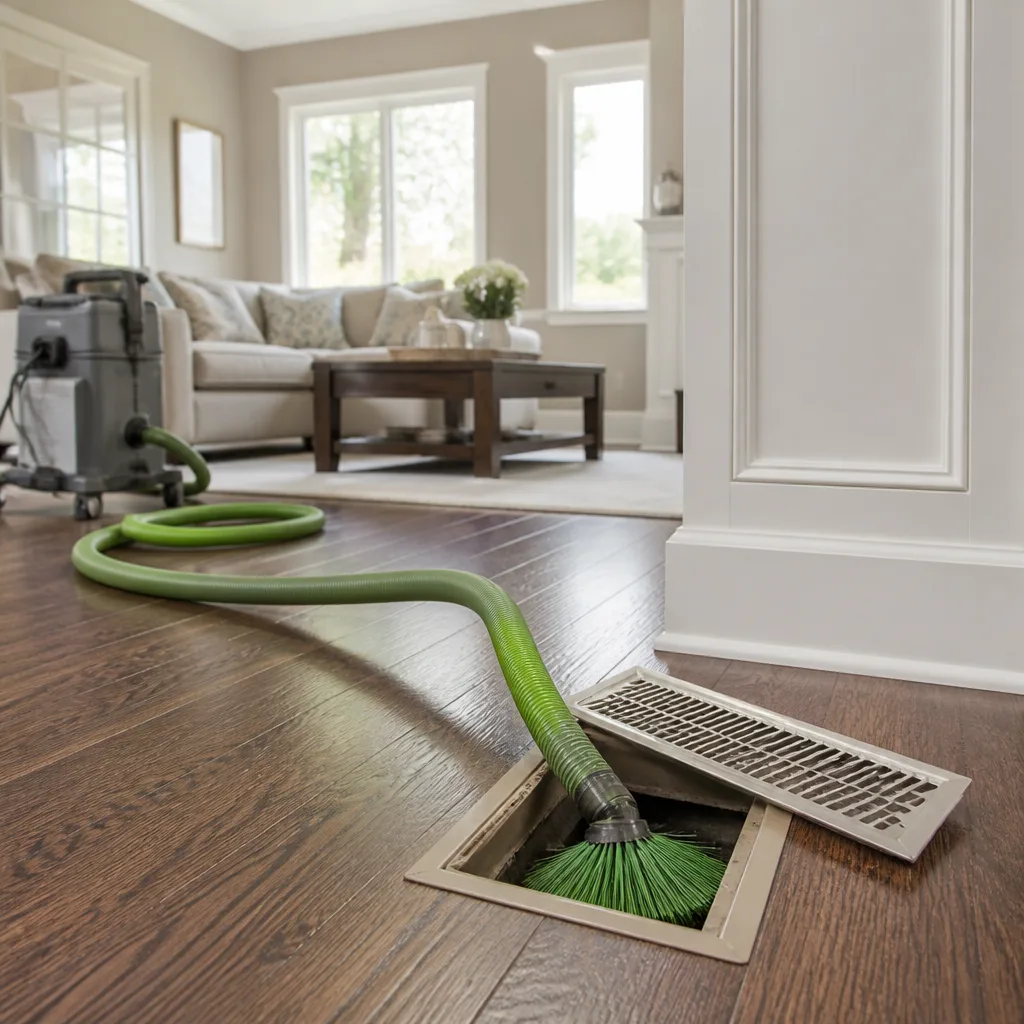 Whole-home duct cleaning
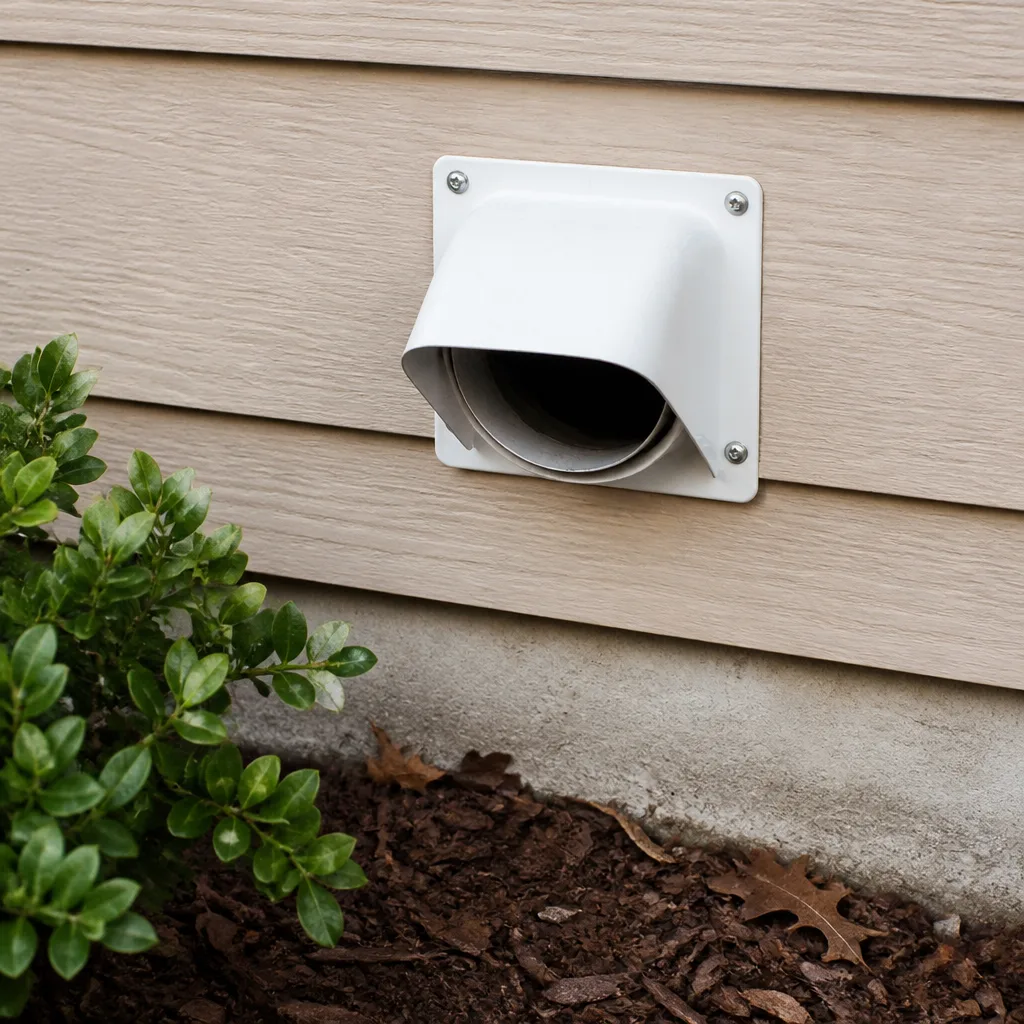 Dryer vent cleaning
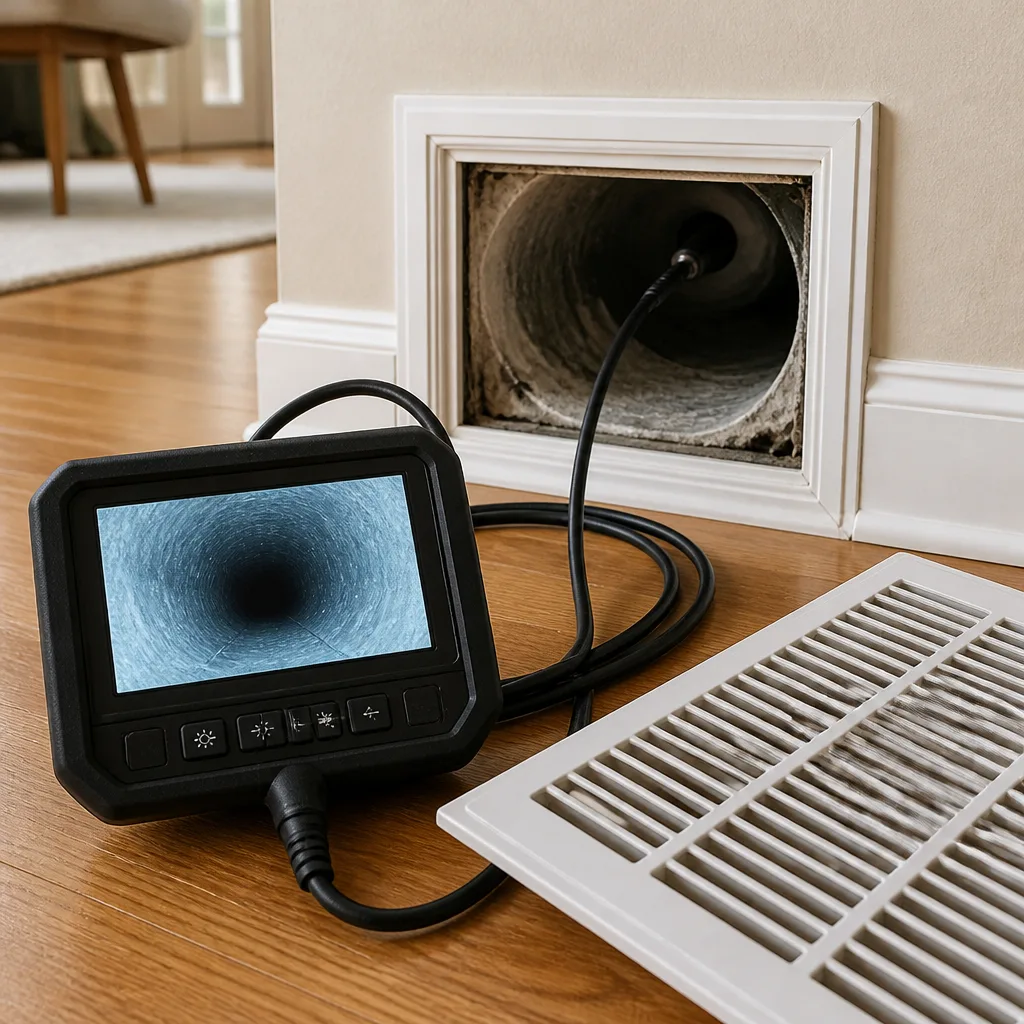 Camera inspection
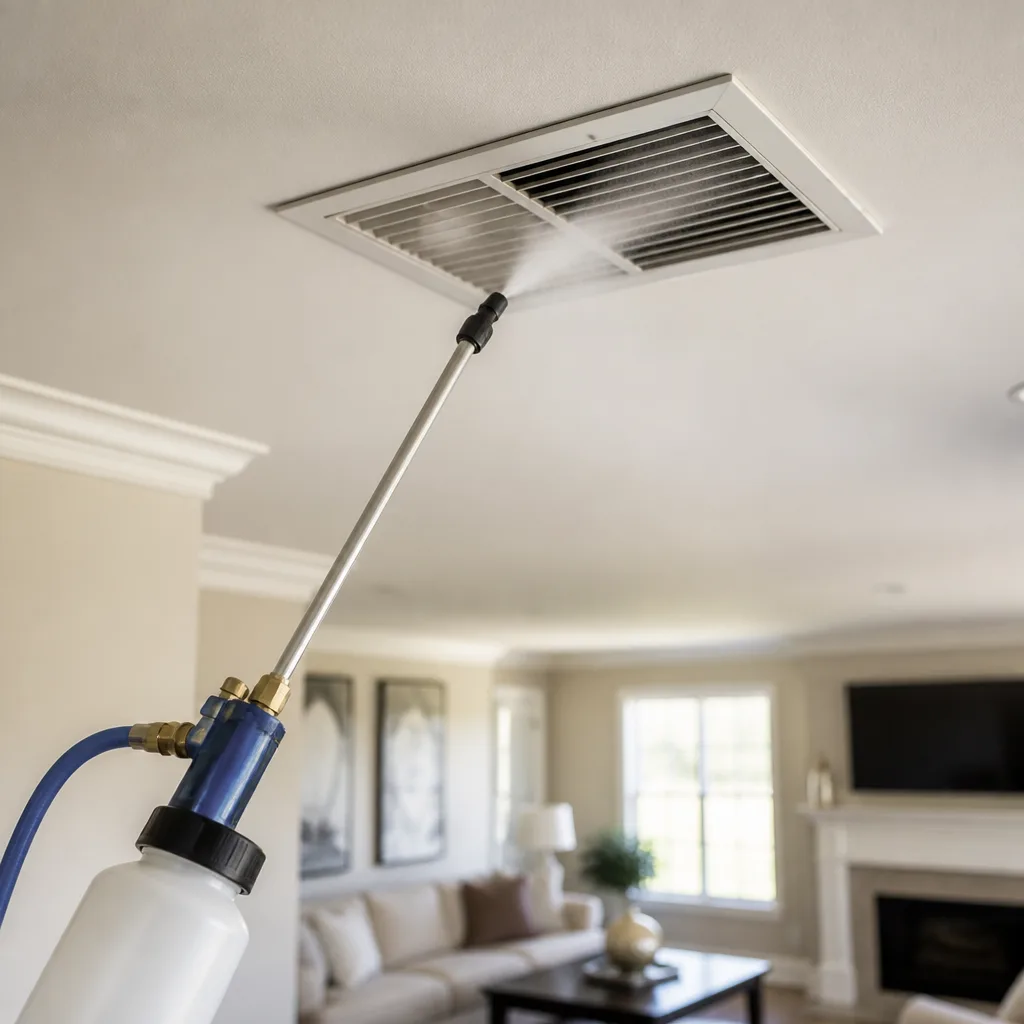 Sanitizing & deodorizing
Whole-system duct and dryer vent check with before-and-after photos - you see exactly what came out of your vents
That "$99 whole-house special" is a bait ad - the real number appears once they are in your hallway, or the "clean" is a shop-vac at the register. We photograph the inside of your ducts before and after instead.
The Complete Guide to Air Duct Cleaning in Tempe
Most homeowners in Tempe think about duct cleaning only when a register starts whistling or a musty smell shows up in the hallway. That’s backwards. The dust that builds up inside your ductwork doesn’t announce itself until airflow has already dropped. A Tempe home runs its cooling system for most of the year, so the ductwork processes far more air and far more particulate than a system in a milder climate ever would. Here’s what most guides get wrong: they treat duct cleaning as a register wipe-down. A real job maps the whole airflow pathway. This guide walks you through that pathway, explains what Tempe’s dust actually is, and shows you what a complete cleaning looks like versus a cosmetic one.
Quick Answer
Air duct cleaning in Tempe removes accumulated dust, caliche particulate, and monsoon-season debris from the entire airflow pathway – supply ducts, return ducts, the plenum, the air handler cabinet, and the evaporator coil. A complete job uses mechanical agitation combined with negative-pressure capture, not a shop vac at the registers. The difference shows up in airflow and in what comes out of the system, not just in how the vents look.
Styles & brands we work with
- Whole-home duct cleaning
- Dryer vent cleaning
- Camera inspection
- Sanitizing & deodorizing
Table of Contents
- Why Tempe Duct Contamination Looks Different
- The Anatomy of Your Airflow Pathway
- What Professional Equipment Actually Does
- What a Borescope Inspection Reveals
- How a Complete Cleaning Job Works
- Restoring Airflow Versus Cosmetic Cleaning
- Your Dryer Vent Is a Fire Risk
- Filtration After Cleaning: Honeywell and Aprilaire
Why Tempe Duct Contamination Looks Different
Tempe sits on soil with a high caliche content – that calcium carbonate hardpan that turns to fine alkaline dust when it’s disturbed and blown around. Add the haboob season, when dust storms roll through the Valley and push particulate into every gap in a building envelope, and you get a dust profile in your ducts that a cleaning guide written for a Midwest home won’t recognize. The particles are finer and more abrasive. They carry alkalinity. And they don’t settle the way heavier dirt does.
Then there’s the cooling season. A home in Tempe runs its air handler for the better part of the year, which means the ductwork is under constant airflow. That airflow is what pushes particulate past the filter and deposits it along the walls of the supply and return runs. In a climate with a short cooling season, the same home might accumulate a fraction of what Tempe homes accumulate between cleanings.
Monsoon season adds another layer. When humidity spikes before and after a storm, dust that has settled inside ductwork can clump and stick to surfaces it would otherwise slide off. That’s often when homeowners in neighborhoods like Maple-Ash or the areas around Arizona State University start noticing a musty smell that wasn’t there in the dry months. It isn’t necessarily mold. It’s often damp dust and debris that has become a substrate.
Understanding this matters because it changes what “clean” means. A Tempe duct system needs mechanical agitation strong enough to break alkaline dust off the duct walls, not just airflow to push it around. That’s where equipment choice becomes the whole story.
The Anatomy of Your Airflow Pathway
Your duct system isn’t a single pipe. It’s a circuit, and every segment matters. When a cleaning skips a segment, the job is incomplete, even if the registers look spotless.
The segments that make up the pathway
- Return ducts. These pull air from the living space back to the air handler. They carry the heaviest dust load because they’re the intake side, and in Tempe homes they’re often the dirtiest segment.
- The plenum. The transition box where the return connects to the air handler and where conditioned air leaves the unit. It traps debris that falls out of the airstream.
- The air handler cabinet. The metal box housing the blower and coil. Dust collects on the blower wheel and the interior panels.
- The evaporator coil. The cooling coil. When it’s fouled, it can’t transfer heat efficiently, and airflow drops.
- Supply ducts. The runs that deliver conditioned air to each room. These carry the particulate that made it past the coil.
- Registers and grilles. The visible endpoints. They’re the least important part of the job and the most photographed by companies that clean cosmetically.
Why does skipping any segment void the cleaning? Because the circuit is continuous. Cleaning the supply runs while leaving the return plenum fouled means the moment the system runs again, debris from the uncleaned segment migrates into the cleaned one. The job has to be done as a system, which is why we treat the full pathway as the unit of work rather than the visible vents.
What Professional Equipment Actually Does
Most duct cleaning setups you’ll see advertised in Tempe are variations on a shop vacuum and a long hose. Mechanically, that’s a weak vacuum pulling on a small area with no way to agitate debris off the duct walls. It can pull loose dust from a register boot. It cannot break the caked-on layer that alkaline dust forms on the interior of a supply run.
Rotary-brush agitation plus negative pressure
A Rotobrush rotary-brush system does two things at once. The brush physically scrubs the interior walls of the duct, dislodging compacted debris, while a vacuum line captures what the brush loosens. It’s the difference between sweeping a floor and wiping it.
Nikro negative-air machines
Nikro negative-air equipment maintains a constant negative pressure inside the duct system during the cleaning. That negative pressure is what prevents cross-contamination. Without it, dislodged debris can blow back into the living space through other registers while you’re cleaning one. With it, loosened particulate is captured at the source and pulled into filtration.
Abatement Technologies filtration
We also work with Abatement Technologies air filtration units – the same class of equipment used in mold and remediation projects. That containment capability is what separates a cleaning that captures debris from one that redistributes it through the home.
Combined, the process is straightforward: agitate mechanically, hold negative pressure, capture through filtration. That’s the method. Everything else is packaging.
What a Borescope Inspection Reveals
A flashlight walk-through tells you what’s visible at the registers. It tells you almost nothing about the interior condition of the duct runs. A borescope camera is a small flexible scope that can be fed through the duct system to look at the actual interior surfaces.
What the camera finds
- Debris depth. A borescope shows how thick the dust layer is on the duct walls, not just whether dust exists.
- Debris type. Alkaline dust, construction debris from a prior renovation, or biological growth each call for a different response.
- Compromised ductwork. Disconnected joints, crushed flex runs, and gaps at the boots where ducts meet the registers. These are common causes of pressure loss and are easily missed without a camera.
- Coil condition. A glance at the evaporator coil through a borescope is often the fastest way to know whether fouling is contributing to poor cooling.
- Contamination migration. Whether debris in an uncleaned return segment is likely to reenter cleaned supply runs once airflow resumes.
This matters because a cleaning should begin with diagnosis. If the inspection finds compromised ductwork, cleaning without addressing it merely cleans ductwork that will leak air and debris back into the system. That’s the reason we offer air duct repair as a named service rather than handing you a report and moving on.
How a Complete Cleaning Job Works
Tempe homeowners want to know what actually happens during a job, not a vague summary. Here’s what a complete cleaning looks like when it’s done as a system.
- Set up containment. Registers are opened, and the equipment is staged so negative pressure can be maintained throughout.
- Protect the interior. We use Guardsman surface-protection products to safeguard floors, walls, and furnishings through the service process.
- Borescope the system. Interior surfaces and the coil are inspected before any cleaning starts.
- Establish negative pressure. The Nikro negative-air machine is connected and running, so every segment is under constant draw.
- Agitate each segment. The Rotobrush rotary brush is fed through the return runs, plenum, and supply branches in sequence, dislodging compacted debris from the duct walls.
- Capture and filter. Dislodged debris is pulled through Abatement Technologies filtration and captured.
- Clean the air handler and coil. The blower wheel and evaporator coil are cleaned as part of the job, not left for a later visit.
- Inspect after cleaning. A second borescope pass confirms the result.
- Document. Photos of your own ducts, before and after, are part of the deliverable. You see what came out.
- Recommend filtration. If the system needs better filtration after cleaning, we discuss Honeywell and Aprilaire options.
That’s the process at a systems level. If a company’s scope stops at step five, the job is not complete, regardless of what the invoice says. Our air duct cleaning service follows the full pathway because that’s the only version that restores airflow.
Restoring Airflow Versus Cosmetic Cleaning
Here’s a distinction most Tempe homeowners haven’t heard. There are two very different outcomes a duct cleaning can produce, and they look identical from the register.
A cosmetic cleaning
The registers are wiped down. Maybe the visible boot behind the grille is vacuumed. The duct walls further inside are untouched. Airflow, measured in cubic feet per minute (CFM) at the registers, is barely changed. If the reason you called was uneven cooling, this cleaning won’t fix it.
A cleaning that restores airflow
The full pathway is agitated and cleaned, the coil is fouled no more, and the compromised duct segments have been identified or repaired. CFM at the registers increases measurably because the restrictions inside the system are gone. If you had a bedroom that ran warm, this is the version of the job that changes it.
How do you tell which one you got? Ask for borescope photos before and after, and ask for a measurement at the registers. A company that can’t produce either is producing cosmetic work. The difference between a cleaning that makes your registers look presentable and one that restores how your system actually runs is entirely about what happens inside the duct and at the coil. Our duct cleaning Tempe service is built around that internal standard.
Your Dryer Vent Is a Fire Risk
Duct cleaning and dryer vent cleaning are two sides of the same “airflow matters” principle. A dryer vent clogged with lint is a common cause of residential fires. The lint traps heat, the heat ignites, and the result is a fire that starts inside the wall cavity where it’s hardest to fight.
Tempe homes often have dryer vents that run a longer distance than expected – particularly in multi-story builds where the vent routes up and across before exiting. Every foot of length adds friction, and lint accumulates at the bends. A dryer that used to dry a load in one cycle and now takes two is a warning sign, not a nuisance.
Cleaning a dryer vent is a mechanical job, similar in principle to duct cleaning. Brush through the run, capture the lint, verify the run is clear. It’s a short job and it’s not a “when you get around to it” job. dryer vent cleaning is one of the three services we run in a single visit scope alongside duct cleaning and duct repair, so you’re not coordinating multiple contractors for one system-level correction.
Filtration After Cleaning: Honeywell and Aprilaire
Clean ducts are the starting point. The right filtration keeps them that way.
Most homes in Tempe run a standard 1-inch pleated filter in the return grille. It catches larger particulate but does little against the finer alkaline dust that comes with the soil. For homes with allergy concerns, a high-efficiency media cabinet from Honeywell or Aprilaire installs at the air handler and provides deeper filtration across a larger surface area. The filter lasts longer, catches more, and holds the duct system cleaner between cleanings.
When to consider an upgrade
- You’ve just had the ducts cleaned and want to protect that investment.
- Standard filters are being loaded with dust faster than usual.
- Occupants are sensitive to particulate, especially during haboob season.
- You want a filtration solution integrated at the air handler rather than a grille filter.
We work with Honeywell and Aprilaire because they’re established product lines with known standards. Post-cleaning filtration recommendations are made after the cleaning is verified, not before.
Common Mistakes to Avoid
- Approving a cleaning that starts and ends at the registers. If the crew never opens the plenum or touches the coil, the job isn’t about airflow. Ask for borescope photos of interior duct surfaces.
- Ignoring the return side. In Tempe homes, the return ducts usually carry the heaviest load. A company that cleans supply runs only is cleaning the cleaner side of the system.
- Skipping the dryer vent. Dryer vent cleaning is a fire-safety measure. Scheduling duct cleaning without booking the dryer vent is a missed opportunity.
- Assuming a shop vac setup is equivalent. Mechanically, a shop vac cannot agitate compacted alkaline dust from duct walls. It pulls what’s loose. It does not scrub.
- Cleaning without first inspecting for compromised ductwork. If the ducts are torn, disconnected, or crushed, cleaning them first just moves the dust into a system that will leak debris back into the house.
- Using a grille filter as the only filtration. Standard 1-inch filters catch coarser dust but leave the fine particulate that sources most complaints.
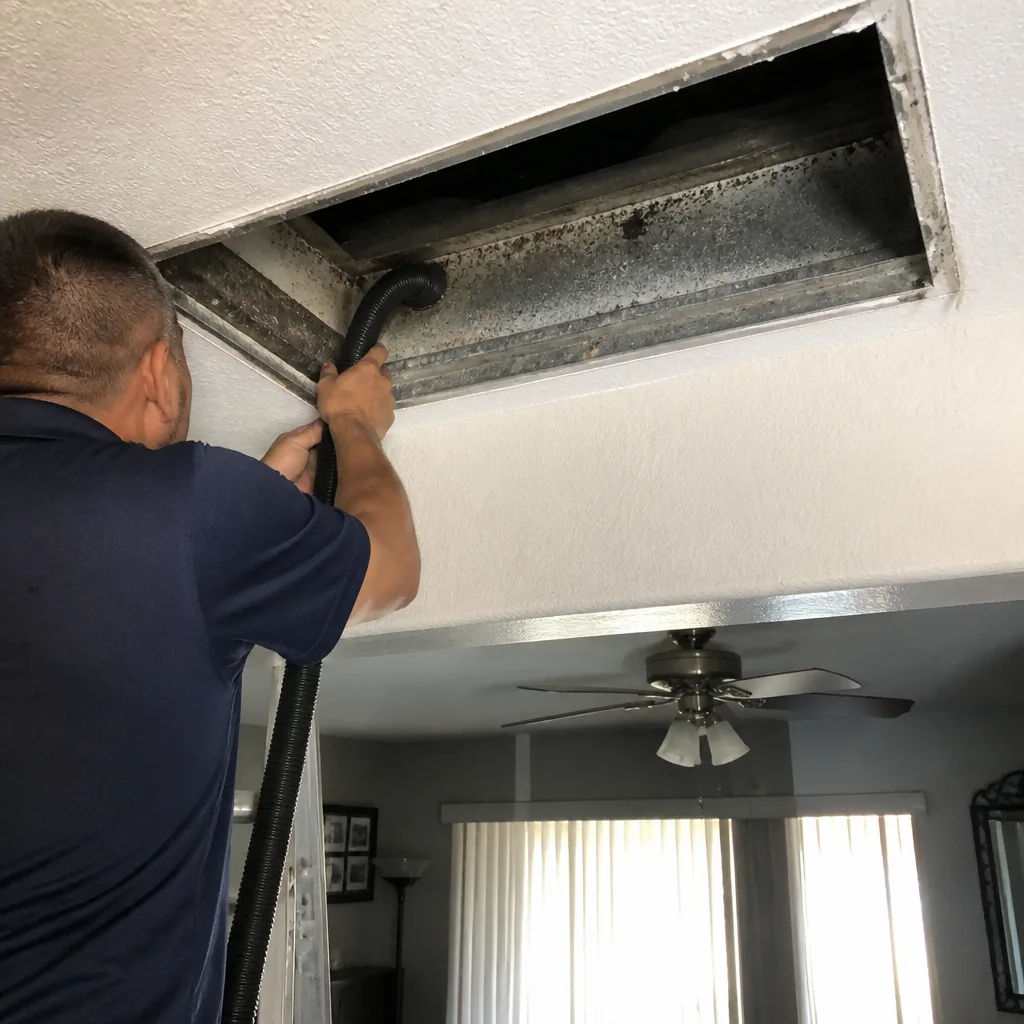
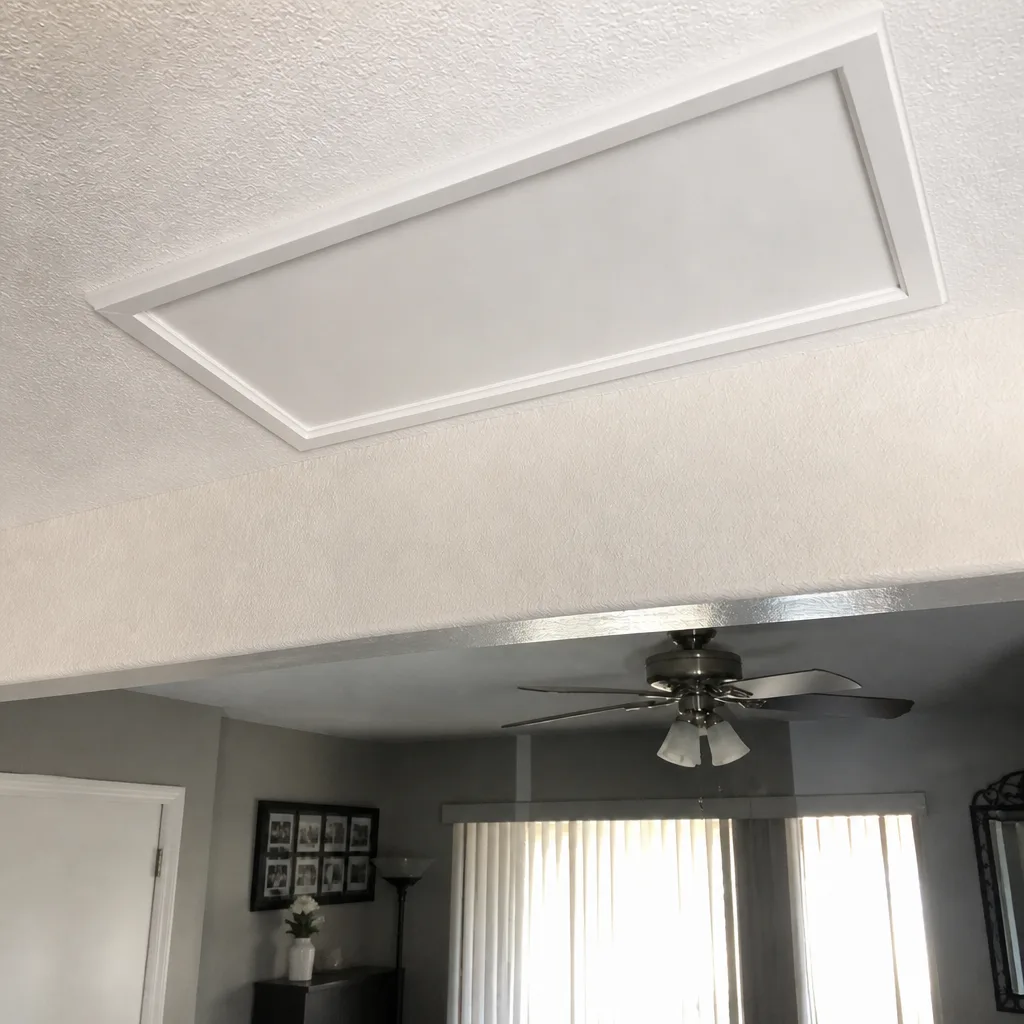
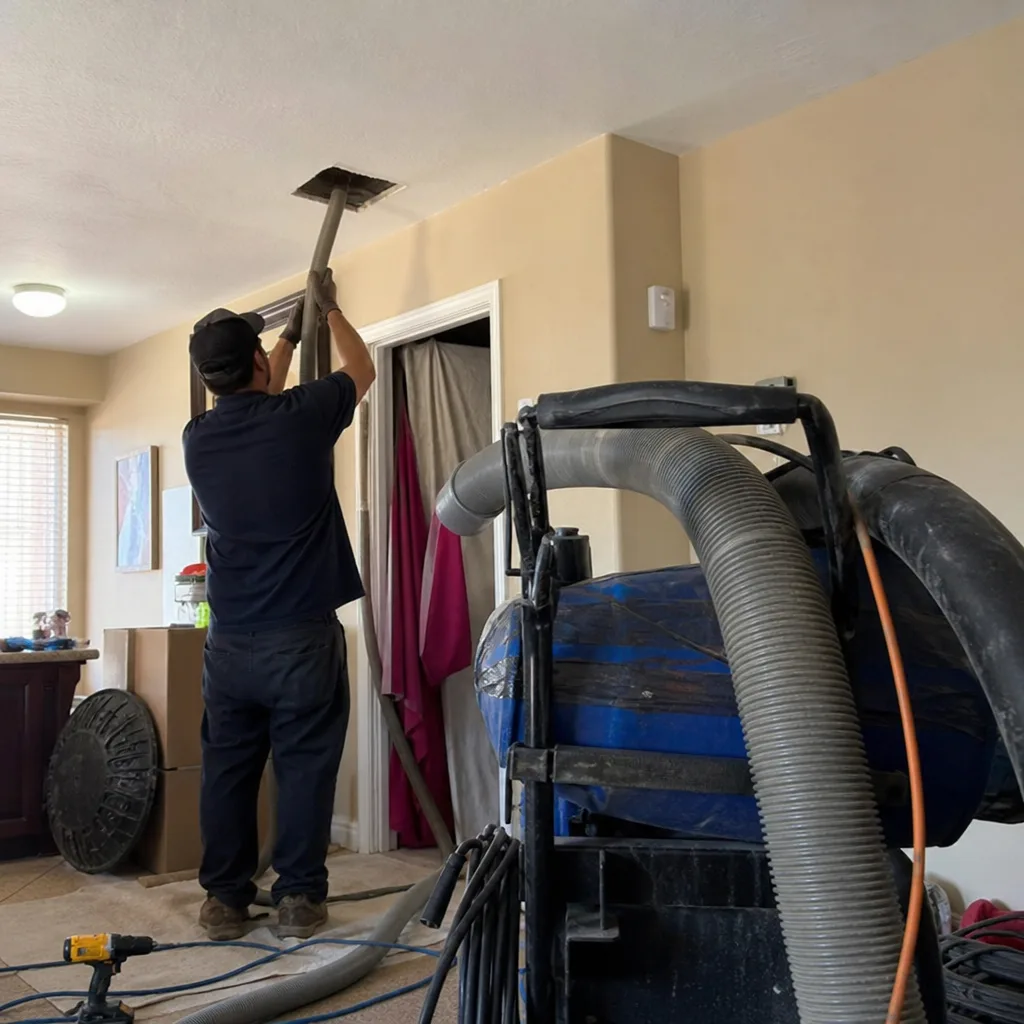
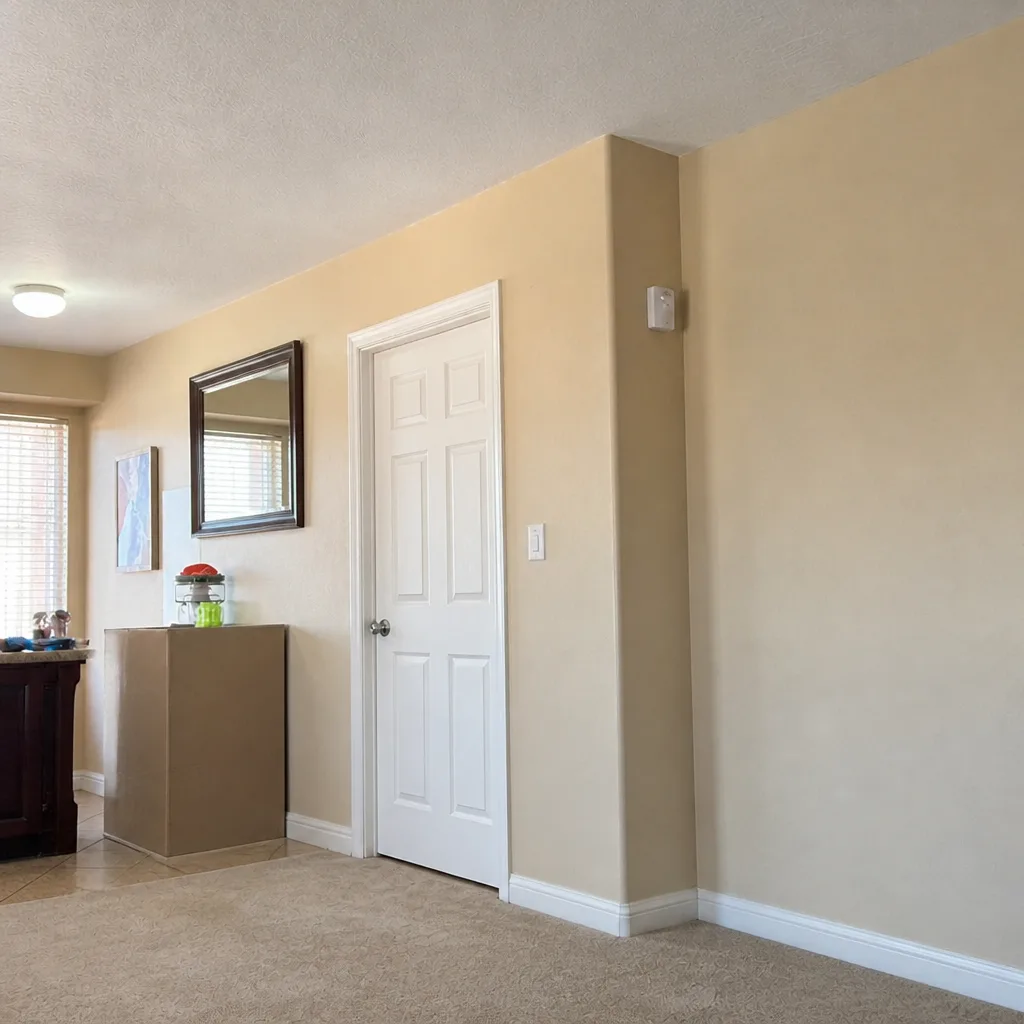
- Not requesting before-and-after photos of your own ducts. Documentation is the proof that the work happened. Photos of your specific system, not stock photos, are what matter.
See the difference
 Before
 After
 Before
 After
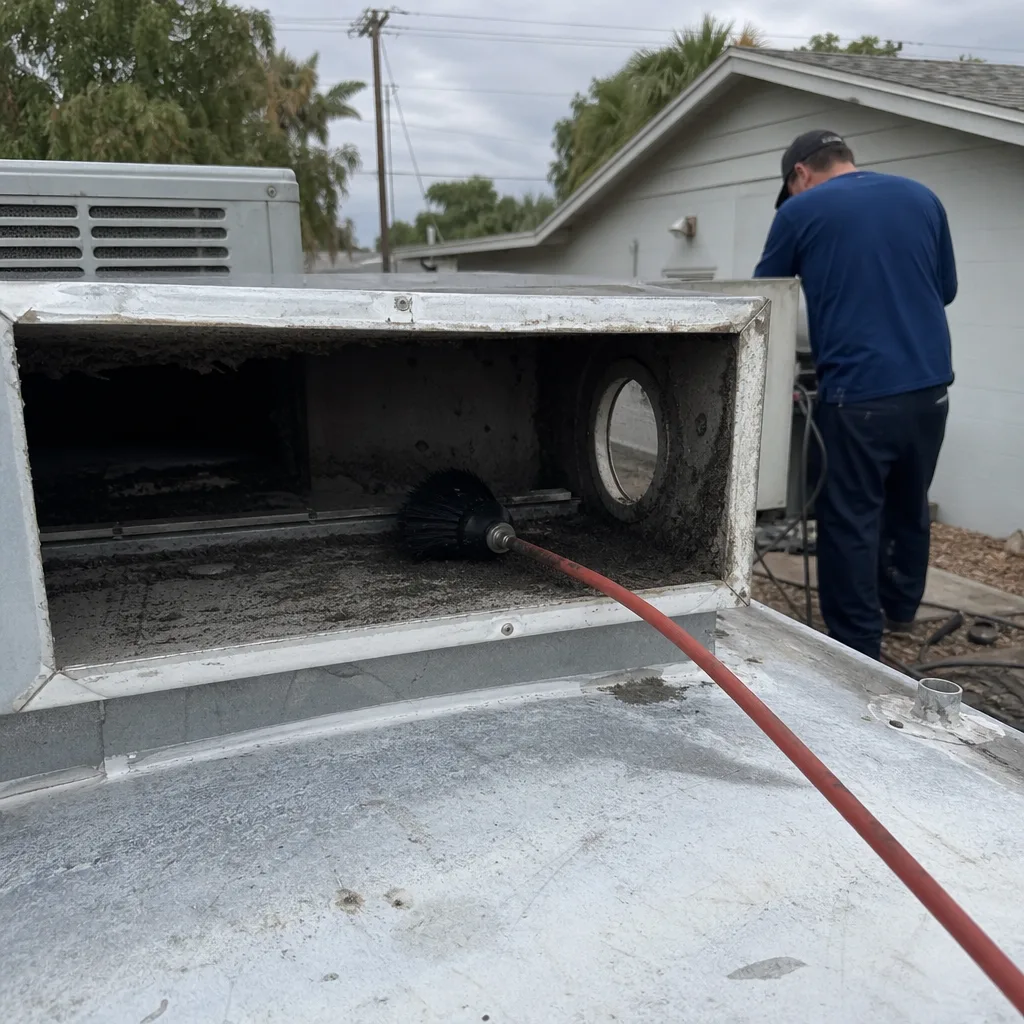 Before
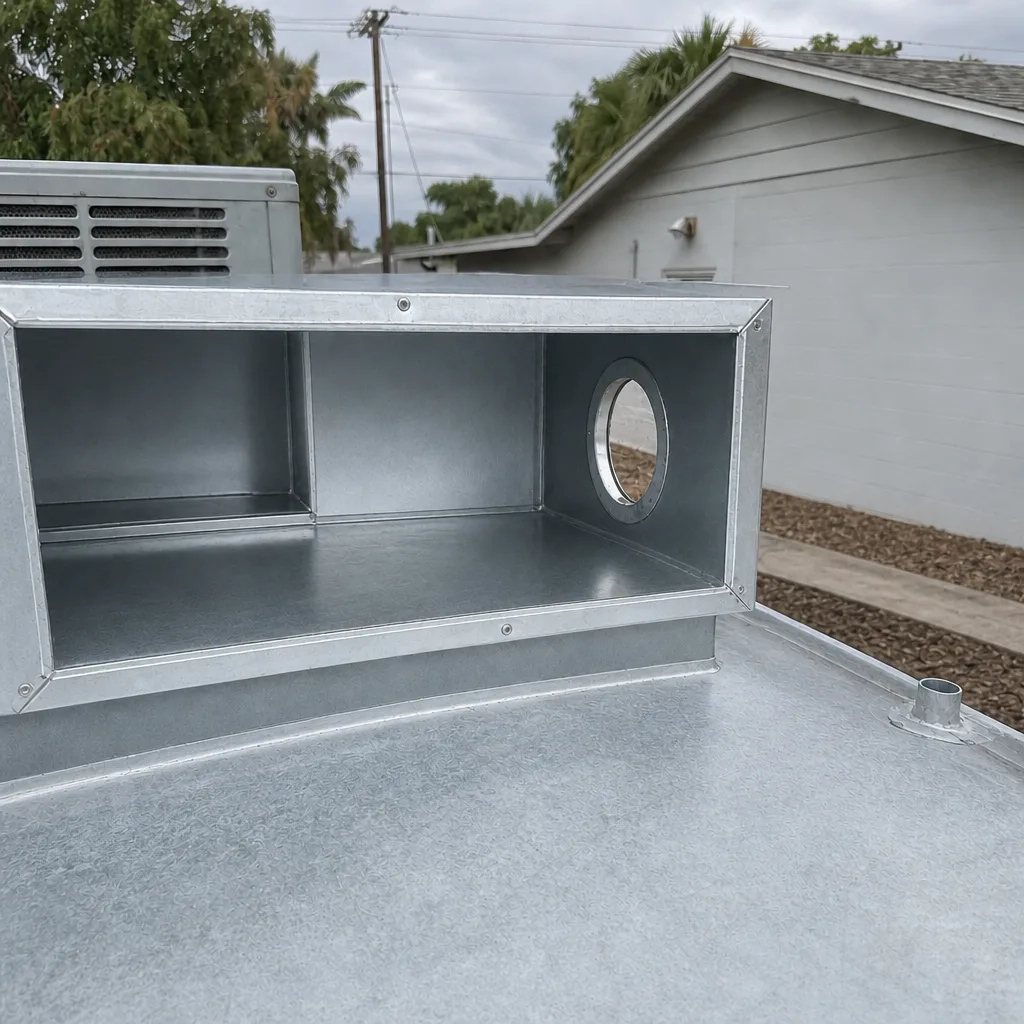 After
When to Call a Professional
If you’re seeing any of the following, it’s worth calling for an inspection. Uneven cooling between rooms, especially a bedroom that’s always warmer than the rest of the house. A musty smell that appears when the air handler starts. Dust settling on horizontal surfaces faster than it used to. A dryer that needs two cycles to finish a load. Visible debris at the registers when you open them up. A recent renovation that pushed construction dust through the system. Or simply a strong urge to know what’s actually inside the ducts after a few years of Tempe dust.
Some of these point to cleaning. Some point to repair. A borescope inspection tells you which. Duct Cleaning Tempe offers free estimates in Tempe – call (866) 261-1801. We answer 24/7. Fast dispatch from 7am to 7pm, Sunday through Friday.
Frequently Asked Questions
Every two to four years is a reasonable baseline for most Tempe homes, though the honest answer depends on your specific conditions. Homes near arterial roads, homes with pets, homes that have been through a renovation, and homes where occupants have respiratory sensitivities often land on the shorter end. The alkaline dust that comes off Tempe’s caliche-heavy soil loads a system faster than the dust in milder climates, and the long cooling season means the system is moving that dust almost continuously. A borescope inspection is the only reliable way to know your actual interval. Call (866) 261-1801 for a free estimate if you’re not sure where you stand.
Because they’re quoting a different job. A low quote is typically a shop-vac pull at the registers with no rotary agitation, no negative-pressure containment, and no work inside the plenum or at the coil. It looks like duct cleaning on the invoice. Mechanically, it’s a light surface pass. When the system runs afterward, nothing about its airflow has actually changed. The right question isn’t which quote is lower. It’s which quote describes the full pathway, and can produce borescope photos of what they actually found. Call (866) 261-1801 for an exact quote – estimates are free.
The honest answer is that it depends on system size, number of supply and return runs, and whether the job includes the coil and air handler. Whole-system pricing for a typical Tempe home generally falls in a mid-hundreds range per system, with larger or more complex systems running higher. We don’t quote per-vent numbers, because a per-vent price hides the fact that the plenum, coil, and air handler are where the real work happens. The written estimate sets the final price, and you get before-and-after photos of your own ducts. Call (866) 261-1801 for an exact quote – estimates are free.
Ask for borescope photos of your duct interiors before and after the job. That’s the documentation standard, and it’s what we provide. An honest company will let you see the before and after of your specific system, not a generic photo. If a company can’t answer that request, that’s useful information. Call (866) 261-1801 to schedule an inspection.
Yes. Dryer vent cleaning is one of our three core services, alongside duct cleaning and duct repair. In Tempe homes with long or routed vent runs, lint accumulation happens at the bends and the fire risk that comes with it is real. We handle all three services in a single visit scope where possible. Call (866) 261-1801 to book.
We serve homeowners and property managers across Tempe and the surrounding Valley, from neighborhoods near ASU through the areas along the Loop 101 and US-60 corridors. If you’re in Tempe, you’re in our service area. For details on the areas we work, see our Tempe page.
The Bottom Line
The best air duct cleaning in Tempe is the one that treats the whole airflow pathway – returns, plenum, air handler, coil, and supply runs – as the unit of work, not the visible registers. Tempe’s alkaline soil dust and long cooling season load a system harder than most climates, and a cleaning that only handles the surface never actually restores airflow. Mechanical agitation, negative-pressure capture, and honest borescope documentation are what separate a real cleaning from a cosmetic one. If you’re ready to see what’s actually inside your ducts, call (866) 261-1801 for a free estimate.
Written by the team at Duct Cleaning Tempe.